In June 2022 I put 6.4 kWp of panels on our roof, with a Fronius GEN24 inverter, a 7.7 kWh BYD battery, an Ohmpilot to dump surplus into the hot water tank and a Wattpilot charger that waited three years for a car. It was about 14 800 € all in. There is no feed-in, not one kilowatt-hour has ever been sold back to the grid. Now, four winters later, I finally went through the electricity bills to see what it did for us.
I have all the electricity invoices back to 2012, and the inverter logged every month since the panels went up. My baseline is 2016 to 2021, 9.5 MWh a year on average, when the house bought every kilowatt-hour it used.
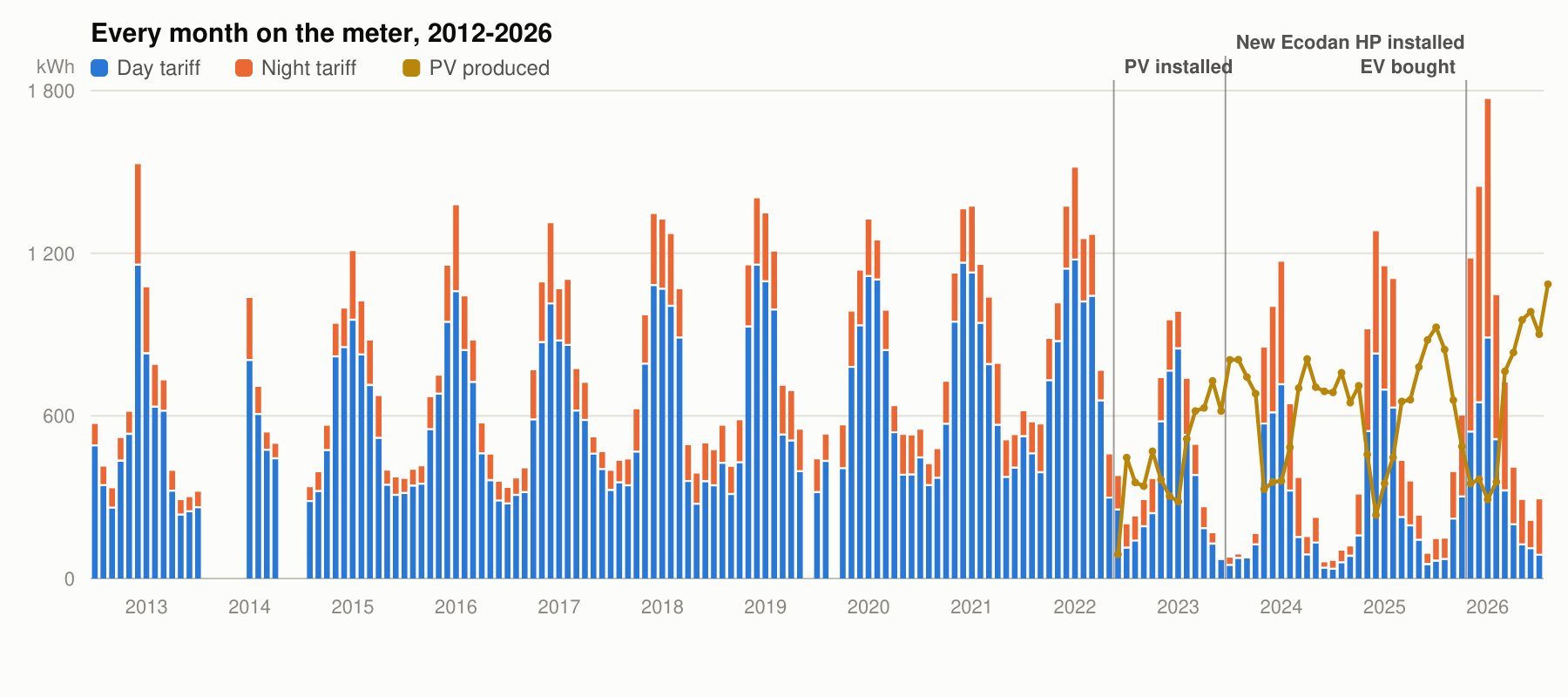
Production by calendar year was on plan against the 7.6 MWh PVGIS promised: 7.1 MWh in 2023, 7.3 MWh in 2024 and 7.4 MWh in 2025. It never ran flat out though. This is a zero-export system, when the battery is full and the house is not drawing the inverter throttles back and that energy is never made. August 2026 was the best month in four years at 1 086 kWh, and nothing changed on the roof, the car was pulling 312 kWh out of it.
From the grid the house bought 5.0, 5.4 and 7.3 MWh in the three full years since the panels, and 8.5 MWh in the twelve months to July 2026. So after roughly 14 800 € I still buy 90% of the electricity I used to buy, the house is outgrowing the roof.
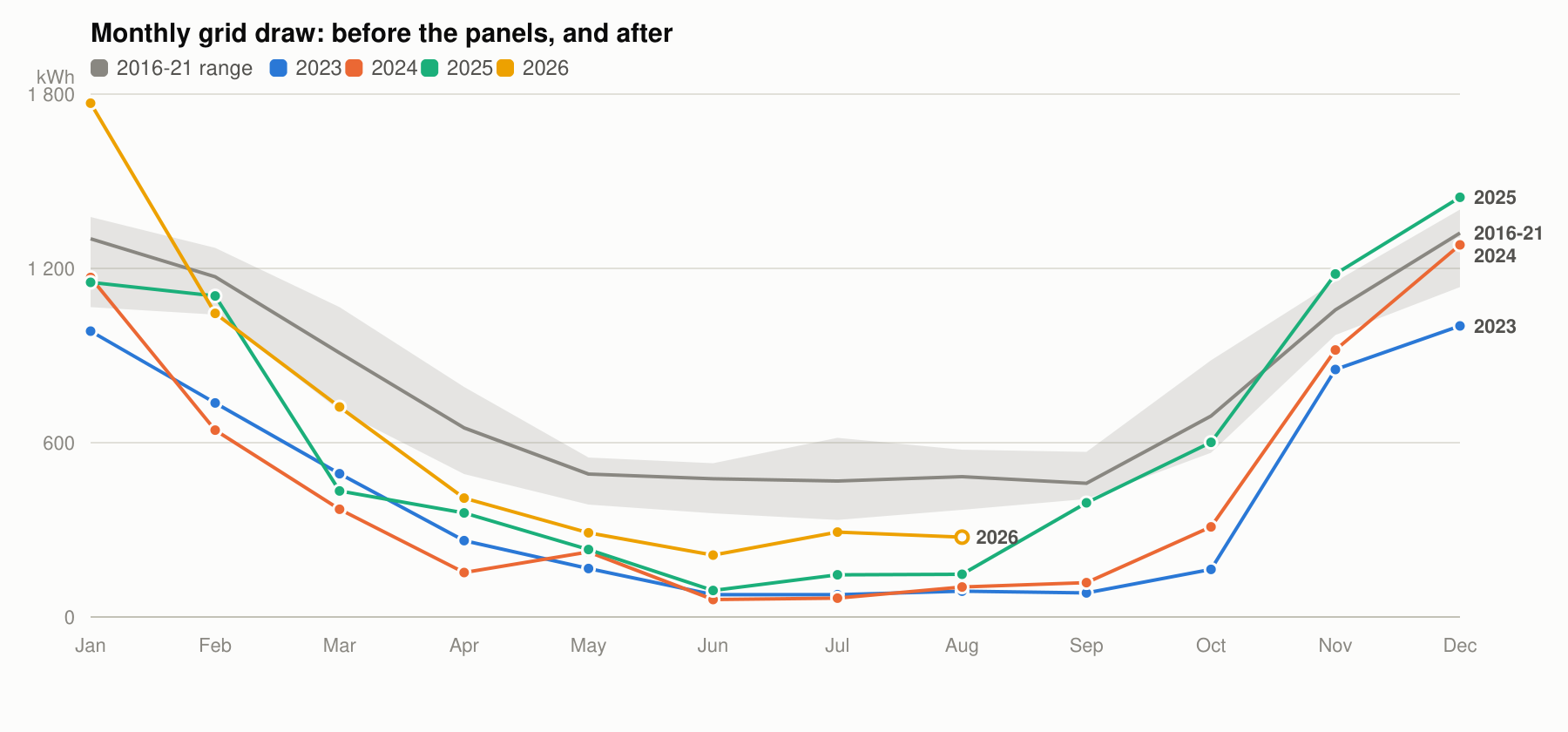
Summers are good. In June to August the house took a sixth of what it used to take from the grid in the first two years, and a quarter in 2025. Winters got worse every year:
- first winter: 30% below baseline
- second: 26% below
- third: 7% below
- last winter: 12% more from the grid than before the panels existed
Six kilowatt-peak on a Sofia roof in January is a rounding error against a heat pump.
Before the panels, night consumption averaged 1 940 kWh a year, nearly all of it water heating on the cheap tariff. In the three full PV years the Ohmpilot put 1 908 kWh a year into the tank, so for 886 € it took a whole category off the bill.
Then the Ecodan took over the hot water (measured, not nameplate, it does it at 2.4 to 3.5 times the efficiency of an immersion element), and since the Tesla arrived in November 2025 the Wattpilot takes the surplus. From January to August the diverter went from 1 400 kWh in 2025 to 771, while the car took 1 566 kWh. I think that is the right way round, the car has no cheaper source and hot water does.
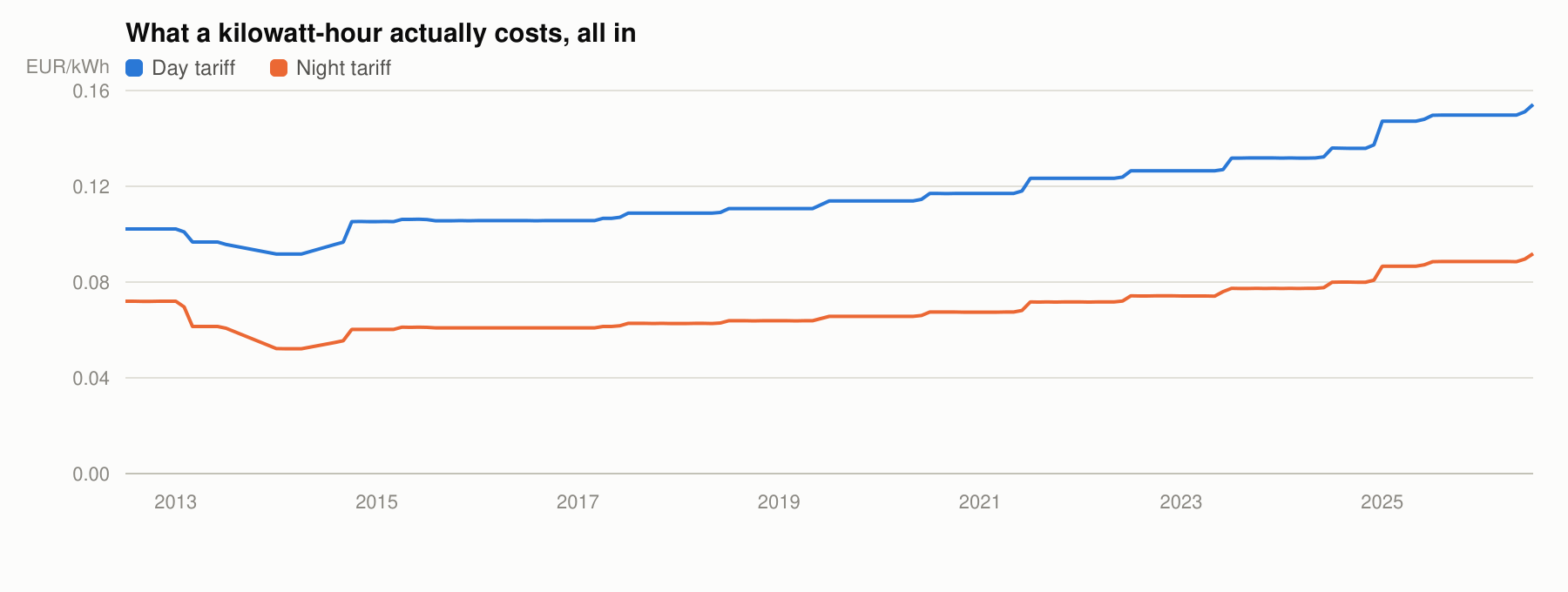
In Bulgaria there is no standing charge on household bills, so a saved kWh is worth the full price, 0.15 €/kWh by day now (up 56% since 2014). Night has been at roughly 59% of day the whole time.
To get the savings I priced every part at the tariff it displaced, using the generation figures I exported from Solar.web with a small exporter I wrote:
| Year | Realized saving |
|---|---|
| 2022, from June | 284 € |
| 2023 | 723 € |
| 2024 | 720 € |
| 2025 | 838 € |
| 2026, to August | 723 € |
| Since June 2022 | 3 288 € |
That is 22% of the system back in a little over four years. The run rate is about 939 €/yr and climbing, but that is the tariff rising and the car arriving, the system is not doing more work.
These are the invoiced amounts, VAT included. Mounting and cabling were never itemized, so I call it 14 800 € and not the 14 500 I quoted at the time.
| Component | € |
|---|---|
| BYD B-Box Premium HVS 7.7 battery, 7.68 kWh | 6 575 |
| 18x Q CELLS Q.PEAK DUO-G9 355 Wp panels | 2 914 |
| Fronius Primo GEN24 6.0 Plus inverter | 2 423 |
| Fronius Ohmpilot | 886 |
| Fronius Wattpilot GO 22 J | 789 |
| Smart meter, surge protection, switchover box, Solar.web, mounting and cabling | ~1 260 |
The battery is 44% of the column. If I split the 939 €/yr by what earns it, the panels, inverter, diverter and charger make about 690 €/yr on 8 225 € (paid back in 12 years, well inside the panel warranty) and the battery about 249 €/yr on 6 575 €, which is 26 years, longer than the pack will live. In January 2026 the house bought 1 700 kWh and put 51 kWh into the battery for the whole month, so 44% of the money I spent was sitting idle in the month the bill peaks.
But I bought it in 2022, on the way out of COVID and in the first months of the war in Ukraine, when storage was the point. The same BYD box sells new for around 3 000 € with VAT today, and at my measured 249 €/yr that is a 12-year payback, the same as the panels. So the battery was never a bad idea, it was a bad price.